The news
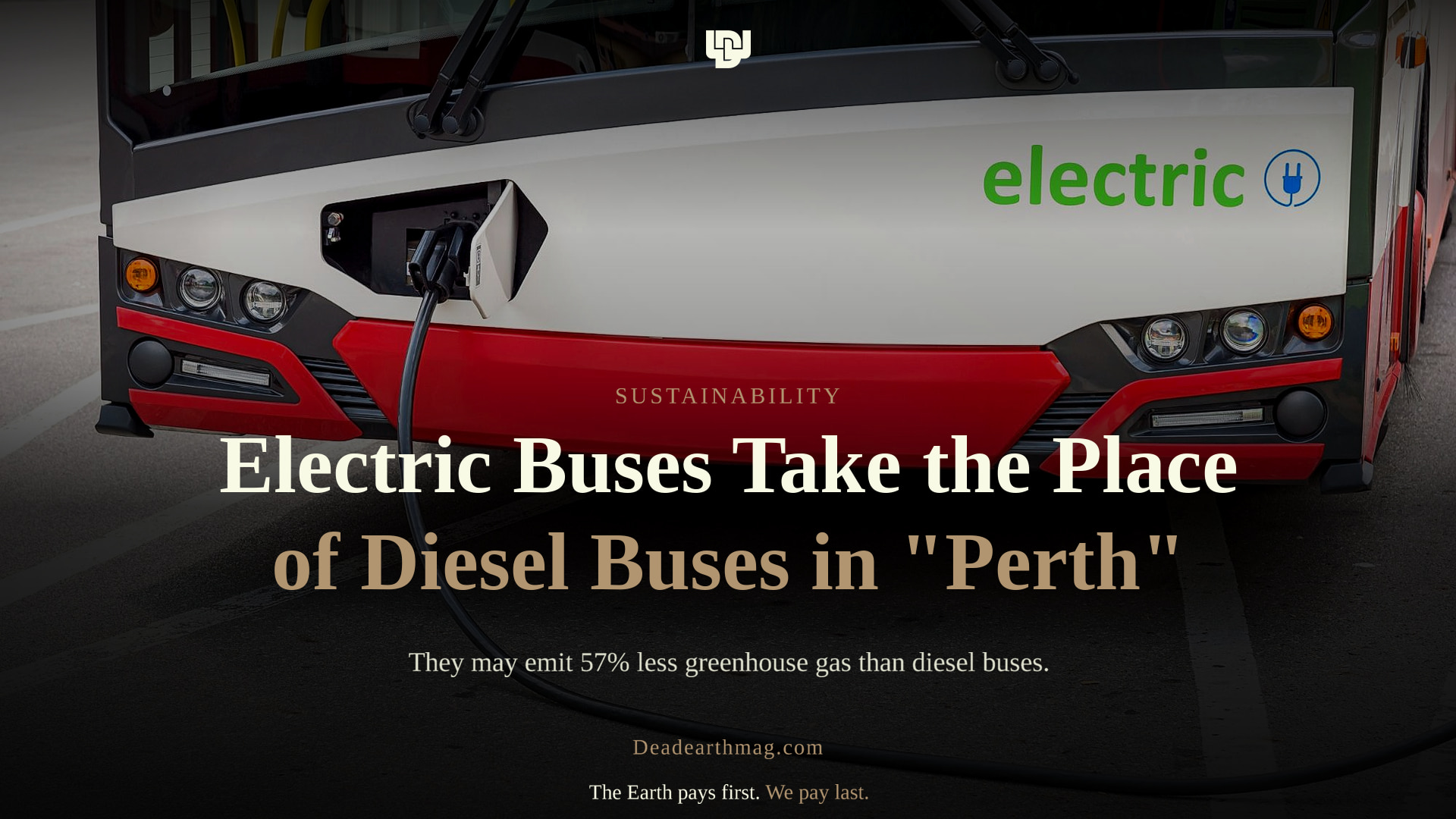
The city of “Perth” in western Australia has opened its largest electric bus depot. The state government announced it on 8 November 2026. Electric buses return to the depot at night and charge there.
The depot is in the suburb of “Bayswater” and has 67 chargers. Today 20 electric buses run from it. The depot has room for 132 buses.
The city’s bus network is called “Transperth”. The government says “Transperth” now has more than 200 electric buses.
At the end of 2024, “Transperth” had 1,690 buses in total. The federal and state governments have put 250 million Australian dollars into electric buses.
How electric buses could hurt the Earth
- Certain: An electric bus has no exhaust, but its power comes from power plants. The power plants of the “Perth” grid emit 0.5 kg of greenhouse gas per kilowatt-hour. This is the official figure for the financial year 2025 to 2026.
- Our estimate: Making the large battery of an electric bus also emits greenhouse gas. According to a 2021 “University of Sydney” study, one electric bus battery holds 345 kilowatt-hours. The Swedish institute “IVL” studied the making of car batteries in 2019. Making each kilowatt-hour of battery emits 61 to 106 kg of greenhouse gas. So making one bus battery emits 21 to 37 tonnes of greenhouse gas.
How electric buses could help the Earth
- The government says: The last diesel bus for “Transperth” was built more than a year ago. Each diesel bus that leaves saves 22,000 litres of diesel a year.
- Our estimate: By the same study, a diesel bus burns 42 litres of diesel per 100 km. That diesel emits 113 kg of greenhouse gas. An electric bus uses 97 kilowatt-hours of electricity over the same distance. The power plants emit 49 kg of greenhouse gas to make that electricity. So the electric bus leaves 57% less greenhouse gas. These figures come from the study, not from the buses in “Perth”. At this saving, the battery’s greenhouse gas is paid back in 6 to 10 months.
- Does it pay? That 250 million dollars bought 130 electric buses and their chargers. By the same study, an electric bus’s electricity costs 43% to 67% of the diesel. Verdict: an electric bus is cheaper to run. But the purchase price is not yet shown to pay back.
Our conclusion
For the Earth, an electric bus is better than a diesel bus. The cleaner the power plants get, the bigger this benefit becomes.
We suggest that “Transperth” publish each year the electricity its buses use and its source. It should also publish the cost per kilometre.
This story shows that technology can be steered toward green. A new machine can take the place of an old one, not stand beside it. We ask every new machine to say what it takes from the Earth.
Tell us what you think
Should your city also retire its diesel buses? Write to us. More in Sustainability. New here? Read our Introduction.
Sources
- Government of Western Australia, Joint media statement - Perth’s largest EV bus depot now operating, 8 November 2026.
- electrive, Perth’s largest electric bus depot opens as Transperth fleet surpasses 200 vehicles, 9 November 2026.
- Public Transport Authority (PTA), Our fleet, number of buses at the end of 2024.
- ABC News, EV buses join Perth’s wider suburban network, 6 July 2025 (the 22,000 litres figure).
- Clean Energy Regulator, Amendments to National Greenhouse and Energy Reporting legislation, SWIS grid factor for the financial year 2025 to 2026.
- Hensher and others, University of Sydney (ITLS), Comparative Assessment of Zero Emission Electric and Hydrogen Buses in Australia, 8 November 2021.
- IVL, New report on climate impact of electric car batteries, November 2019.